- info@routeoptimizationconsultants.com
- 1751 Pinnacle Dr #600d, McLean, VA 22102
- Monday to Friday 9:00AM - 5:00PM
- Let’s Talk: (571) 316-0676

Mobile Workforce Management
Types of Route Optimization Solutions
Specific to the City’s opportunities for route optimization, the City has three types of routing problems to solve:- Planned Routes – With a fixed number of stops that has a very low percentage of changes to the stops on a daily basis, planned routes may be updated annually or semi-annually. Examples are automated residential waste collection, bulky waste collection, and meter reading.
- Dynamic Routes – The stops to be serviced varies on a daily basis and may change during the day as new work orders are created. Examples are waste cart deliveries and line maintenance.
- Combined Planned and Dynamic Routes – The crews have a fixed number of stops with work order stops added in at the beginning of the day and during the day. Examples include water flushing, meter repairs/maintenance, and water quality laboratory sampling.
Mobile Workforce Management Systems
Although definitions vary by vendor, mobile workforce management systems (WFM) generally encompass the above listed Solution Areas with some exceptions. Mobile workforce management systems are a combination of business processes, software and mobile devices used to improve productivity of its field service employees and their associated back office. WFM integrates resource planning, scheduling, dispatch, mobile, and business analytics. The only aspect of the Solution Areas that have not been integrated into these suites of applications and devices has been high density residential routing, which is generally a planned task, whereas, the mobile workforce is regarding the optimization of the daily dynamic work in the field. Components of WFM systems are offered by current City software vendors, SAP, Kronos, CityWorks, and ESRI. There are WFM solutions from vendors solely focused on WFM. There are a myriad of apps and systems being offered for the Solution Areas that also consider themselves to be WFM. WFM is a relatively new and dynamically evolving technology arena with limited standardization.Typical Municipal Utility Systems
Current
Proposed System 1 – Comprehensive Solution Suite
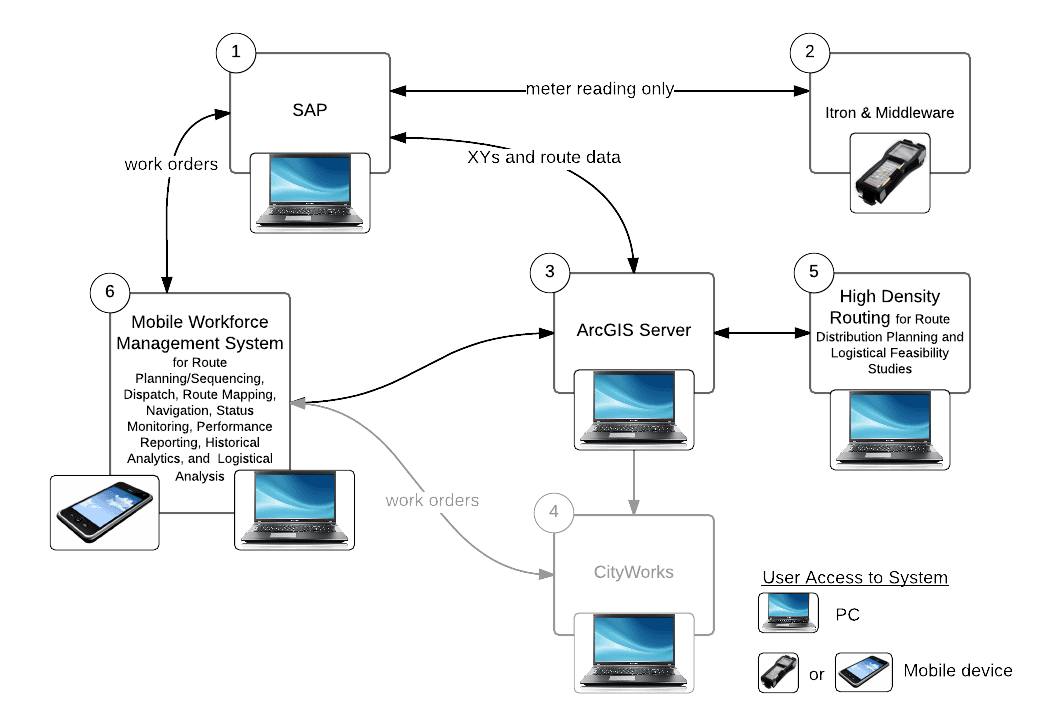
A Comprehensive Solution Suite system minimizes the number of disparate systems by accomplishing most of the requirements via one mobile workforce management system (WFM). WFM becomes the primary system for managing field services. High density routing is the only system that is also added. Integrations between WFM, SAP and ArcGIS Server provide the foundation for consistency between work order, route and asset/customer data.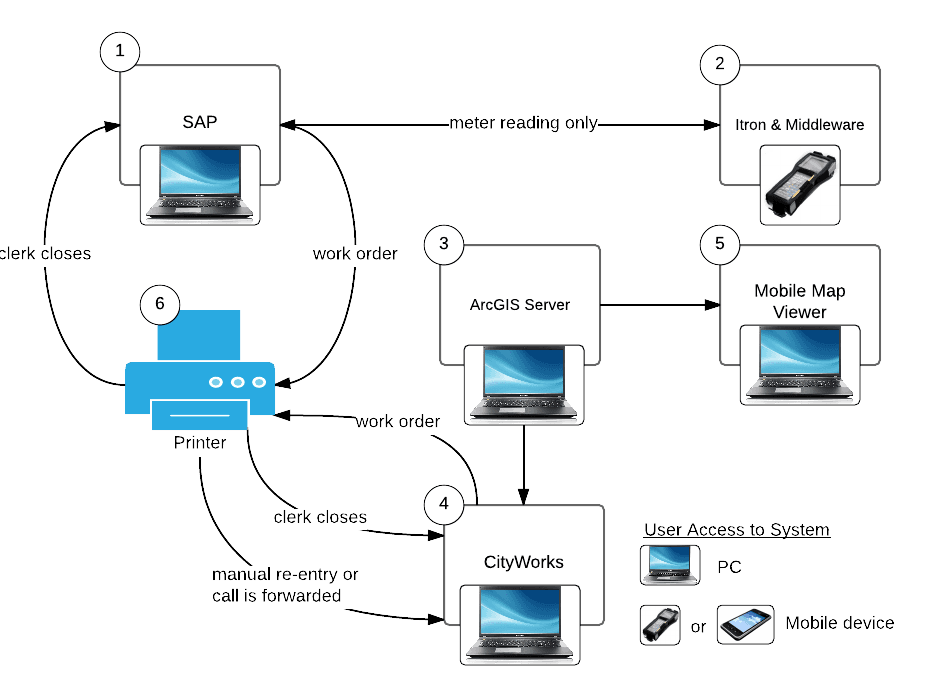
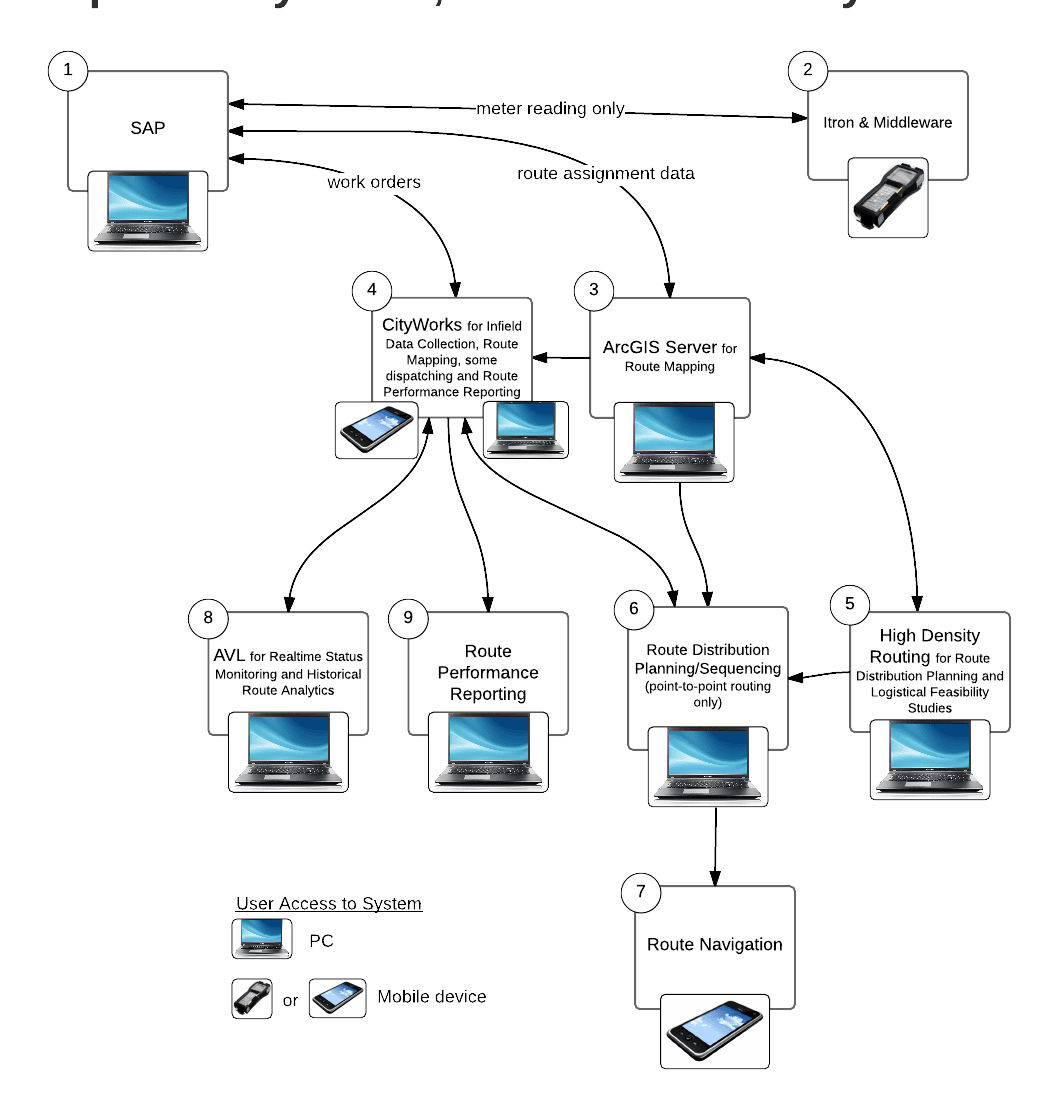
Proposed System 2 – Disparate Systems
A Disparate System maximizes the utilization of existing systems, but is based on adding new systems that are solutions that Cityworks can provide. Cityworks becomes the primary system for managing field services. Significant integration is required. The main challenge with this approach is the integration between SAP and Cityworks.